FENCE RULES – KENTON (COUNTY), KENTUCKY
OVERVIEW
Residential fences are permitted on private property within Kenton County, subject to local regulations. This page applies to properties in the unincorporated areas of Kenton County; incorporated municipalities such as Covington, Florence, Independence, Erlanger and Newport may regulate fences under their own ordinances.
Local fence rules for unincorporated Kenton County appear primarily in the Official Zoning Ordinance of Unincorporated Kenton County, especially Article XIII, Fences, Walls, and Obstruction to View Regulations. For residential lots, Article XIII uses two reference systems: the Type A / Type B / Type C residential placement system shown in Figure 1, and the Class 1 through Class 8 fence-and-wall classification system. This page states those categories in text so the residential fence rules can be read without using the diagram or table separately.
Permit administration is handled through Planning and Development Services of Kenton County, with additional site-specific rules appearing in the Accessory Structures / Pole Barn checklist, Kenton County Subdivision Regulations, Kenton County Code Chapter 95, and PDS floodplain materials.
This page focuses on typical single-family residential fencing. If the jurisdiction’s adopted materials do not state a specific limit or requirement, this page notes that the code does not specify one.
Compiled From the Official Zoning Ordinance of Unincorporated Kenton County, Kenton County Subdivision Regulations, Planning and Development Services of Kenton County Building Codes Administration materials, the PDS Accessory Structures / Pole Barn checklist, Kenton County Chapter 95 Streets and Sidewalks, Kenton County Public Works encroachment materials, and PDS Floodplain Management materials as of June 2026.
GOVERNANCE
Kenton County regulates fences in unincorporated areas through the Official Zoning Ordinance of Unincorporated Kenton County. The ordinance is adopted by the Kenton County Fiscal Court and administered through the Zoning Administrator and Building Inspector structure described in Article XVI.
Planning and Development Services of Kenton County provides zoning, building, planning, subdivision, GIS, infrastructure engineering, and code-enforcement services. The Zoning Administration & Code Enforcement Department reviews zoning permits, addresses zoning information requests, and handles zoning violations for participating jurisdictions.
The county does not use a single standalone residential fence code. Fence rules appear across:
• Article XIII: Fence classes, residential fence placement, height limits, visibility limits, retaining-wall rules, electric/barbed fence restrictions, permit requirements, and structural-member orientation.
• Residential Figure 1: The residential placement diagram assigns fence segments to Type A, Type B, or Type C. Type A and Type B are no-fence categories. Type C is the residential fence-allowed category and allows Classes 1, 2, 3, 4, 5, or 6 up to 72 inches.
• Fence Classes: For residential Type C locations, the allowed classes are Class 1 masonry walls, Class 2 ornamental iron that is 80 percent open, Class 3 woven wire that is 80 percent open, including chain link, Class 4 wood or other materials more than 50 percent open, Class 5 solid wood or other materials less than 50 percent open, and Class 6 hedges.
• Article IX: Traffic-signal interference, corner/curb-cut/railroad visibility, private pool barriers, grading, floodplain, hillside, site-plan, and landscape-context rules.
• Article XVI: Zoning permit and building permit administration.
• PDS Permit Materials: Current permit checklist and zoning-only permit treatment for fences 7 feet or less, unless an in-ground pool is involved.
• Subdivision and Right-of-Way Materials: Plat, easement, lot-line, street, access, drainage, and road-encroachment context.
PERMIT AND APPROVAL REQUIREMENTS
• Fence Permit Required: The zoning ordinance states that no fence may be erected, except as exempted or specified within the ordinance, until required fees have been paid and the necessary permits have been issued by the Zoning Administrator and Building Inspector.
• PDS Permit Checklist: The Accessory Structures / Pole Barn checklist states that construction of a fence requires a permit before construction. The checklist requires a completed Building/Zoning Permit application, associated fee, recorded deed, and a site plan or construction information as applicable.
• Zoning-Only Fence Category: PDS classifies fences that are 7 feet or less as zoning-only permits, unless the property has an in-ground pool. This is a permit-workflow category and does not increase the Article XIII residential Type C height limit where the residential Figure 1 rule applies.
• Building-Permit Relationship: PDS Building Codes Administration lists fences not over 7 feet as exempt from a building permit, while also noting that listed exempt items may still require zoning permits. Fences outside the 7-foot zoning-only category are not described as zoning-only in the published checklist.
• Site Plan Information: The PDS checklist indicates that the site plan may include existing and proposed easements, adjacent streets, property lines with bearings and dimensions, distances to front or right-of-way lines, side lines, and rear lines, driveways, sidewalks, off-street parking areas, erosion-control measures, drainage and grading lines, and topography.
• Retaining Walls: Engineered drawings are required for retaining walls under the PDS accessory-structure checklist. A fence mounted with or on a retaining wall must also follow the zoning ordinance’s retaining-wall fence measurement rules.
• Road or Right-of-Way Encroachment: Where applicable, the PDS checklist requires an encroachment permit from the municipality that owns the road for access to a County or State Road. For roads maintained by Kenton County Public Works, access to a county road or work within the county road right-of-way requires a permit from the County Public Works Department.
• Floodplain Approval: Construction activity in a designated floodplain requires both a state and local floodplain permit. A fence project involving mapped floodplain work, fill, stream alteration, floodway conditions, or other floodplain development may require floodplain review through the state process and PDS local floodplain permitting.
• Pool Barrier Review: A fence used as part of a regulated private swimming pool barrier is reviewed differently from an ordinary yard fence. Private in-ground and above-ground pool barriers must meet the pool-fence height, gate, and class requirements in the zoning ordinance.
• Contractor Information: When a contractor performs the work, the PDS checklist requires contractor information, including the applicable Kenton County Occupational License and proof of Kentucky workers’ compensation coverage or an affidavit of assurances.
FENCE PLACEMENT RULES
• Residential Figure 1 Method: For residential uses in Residential (R) zones, Article XIII does not use a single front-yard, side-yard, and rear-yard sentence for all fences. It assigns fence segments on residential lot diagrams to Type A, Type B, or Type C.
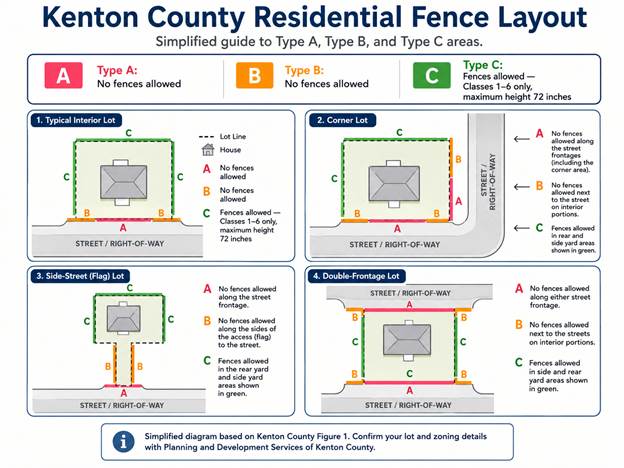
• Type A Areas: Type A is a no-fence category. In the residential Figure 1 layout, Type A appears on street-facing and front-area fence segments, including portions near the public right-of-way and front-yard side segments. A fence is not permitted on a Type A segment.
• Type B Areas: Type B is also a no-fence category. In the residential Figure 1 layout, Type B appears in front-area transition segments between the front no-fence area and the fenceable side/rear portions of the lot. A fence is not permitted on a Type B segment.
• Type A and Type B Practical Effect: For standard residential fence placement, the controlling result is the same for Type A and Type B: the ordinance does not allow a fence on those labeled segments.
• Type C Areas: Type C is the residential fence-allowed category. In the residential Figure 1 layout, Type C appears along the fenceable side and rear portions of the residential lot pattern, including rear lot-line areas, side/rear enclosure areas, and other portions behind the no-fence front-area segments. A Type C segment may use Classes 1, 2, 3, 4, 5, or 6 up to 72 inches.
• Residential Fence Classes in Type C: A Type C residential fence may be a masonry wall, an 80 percent open ornamental iron fence, an 80 percent open woven wire or chain-link fence, a wood or other-material fence that is more than 50 percent open, a solid wood or other-material fence that is less than 50 percent open, or a hedge.
• Overlay Areas: In areas zoned with a PUD, RCD, or MHP Overlay, the location, height, and type of all fences and walls must be as approved by the Planning Commission.
• Lot-Line and Measurement Context: The ordinance measures fence and wall locations from lot lines. The code does not publish a separate numeric setback from interior property lines for standard residential Type C fences apart from the mapped residential fence areas, rights-of-way, easements, and site-specific permit review.
• Rights-of-Way: Fences must not encroach into road rights-of-way. Work involving access to a county road or work within a county road right-of-way requires the applicable Kenton County Public Works permit.
• Easements and Plats: The PDS permit checklist asks for existing and proposed easements on the site plan. Recorded plats, drainage easements, utility easements, access easements, and subdivision restrictions may affect where a fence can be placed.
• Traffic Signals and Streets: No structure, tree, planting, vegetation, sign, fence, or other obstacle may be placed or retained in a way that creates a traffic hazard, interferes with traffic signals, or obstructs visibility at corners, curb cuts, or railroad crossings.
• Utility Safety: Kentucky law requires notice through Kentucky 811 before excavation where Kentucky’s underground utility damage-prevention law applies. For fence projects that involve digging, including fence post holes, notice must be given not less than two full working days and not more than 10 full working days before excavation begins, unless a different future start date is allowed by law. Kentucky locate requests are valid for 21 calendar days from the initial request. Kentucky law also includes exemptions, including certain agricultural tilling and certain nonmechanized excavation on private property where no operator right-of-way or easement is encroached.
FENCE HEIGHT AND VISIBILITY RULES
• Residential Type A: Type A areas are no-fence areas. The ordinance does not provide a height allowance for Type A because fences are not allowed on those segments.
• Residential Type B: Type B areas are no-fence areas. The ordinance does not provide a height allowance for Type B because fences are not allowed on those segments.
• Residential Type C: Type C areas are fence-allowed areas. Residential Type C segments may use Classes 1, 2, 3, 4, 5, or 6 up to 72 inches in height.
• Seven-Foot Permit Line: PDS’s 7-foot zoning-only permit category is a permit-administration rule. It does not replace the Article XIII residential Type C height limit of 72 inches where the residential Figure 1 rule applies.
• Corner and Railroad Visibility: No fence, wall, hedge, or other obstruction above 36 inches, measured above curb level, may be erected, placed, maintained, or continued within the triangular visibility area formed by measuring 50 feet from the intersection of two street right-of-way lines, or from the intersection of a street right-of-way line with a railroad right-of-way line, and joining those points with a straight line.
• Curb Cuts and Traffic Hazards: The ordinance also prohibits a fence or other obstacle from being placed or retained in a way that would create a traffic hazard or obstruct visibility at corners, curb cuts, or railroad crossings.
• Conservation and Agricultural Zones: In Conservation and Agricultural zones, except for the visibility rule in Section 13.0, Class 2 or Class 3 fences may be erected in front yards up to 96 inches. In side and rear yards, Classes 1, 2, 3, 4, 5, 6, or 7 fences and walls may be erected up to 96 inches.
• Flood-Retaining Walls: Class 8 earthen or concrete walls intended to contain or redirect flood waters are permitted in Conservation and Agricultural zones but must conform to the requirements of the Corps of Engineers and/or the engineer, whichever applies.
• Private In-Ground Pools: An in-ground private swimming pool must have a fence or wall around the pool or property, with a self-closing or self-latching door or gate. The fence or wall must be at least 4 feet and not more than 7 feet high, and only Classes 1, 3, or 5 fences are permitted for that pool-barrier use.
• Private Above-Ground Pools: An above-ground private swimming pool must have a fence or wall around the pool or property, with a self-closing or self-latching door or gate. The fence or wall must be at least 4 feet and not more than 7 feet high, and only Classes 1, 3, 4, or 5 fences are permitted. The wall of the above-ground pool may serve as the wall if it is at least 4 feet above the surrounding ground level.
• Fence on Retaining Wall: A combination fence and retaining wall may be erected. The retaining-wall portion may extend up to the higher finished grade, and the fence portion must be of the class and height permitted for the applicable zone. Measurement is made at and along the location of the fence and retaining wall.
• Height Measurement: Fence and wall heights are measured along the fence or wall location.
MATERIAL AND CONSTRUCTION LIMITS
• Residential Type C Materials: Standard residential Type C fences may use only Classes 1, 2, 3, 4, 5, or 6. Those classes are masonry walls, ornamental iron, woven wire including chain link, open wood or other materials, solid wood or other materials, and hedges.
• Class 1 – Masonry Walls: Class 1 means a masonry wall. This class covers wall-type fencing built from masonry materials rather than wire, wood, hedge, or similar open fence materials.
• Class 2 – Ornamental Iron: Class 2 means ornamental iron that is 80 percent open. This class is an open ornamental metal fence type.
• Class 3 – Woven Wire and Chain Link: Class 3 means woven wire that is 80 percent open, including chain link.
• Class 4 – Open Wood or Other Materials: Class 4 means wood or other materials that are more than 50 percent open.
• Class 5 – Solid Wood or Other Materials: Class 5 means solid fences of wood or other materials that are less than 50 percent open.
• Class 6 – Hedges: Class 6 means hedges used as fence or wall-type barriers.
• Class 7 – Barbed Wire or Sharp-Pointed Fences: Class 7 means barbed wire or sharp-pointed fences. Class 7 is not one of the standard residential Type C fence classes. Where Class 7 is permitted, barbed wire or sharp-pointed fencing must start at least 60 inches above ground level, except in areas used for agricultural purposes.
• Class 8 – Flood-Retaining Walls: Class 8 means earthen or concrete walls intended to contain or redirect flood waters. This class is not an ordinary residential yard-fence class and is tied to flood-control wall context.
• Electric Fences: A fence carrying an electrical charge is not permitted in any zone except when used with an agricultural use, and it may not be located along the perimeter with adjacent property.
• Structural Members: Fences must be constructed so that structural members are located on the inside of the fence. The inside is the side facing the property owned by the person building the fence.
• Signs and Advertising: The adopted zoning ordinance does not publish a separate standard residential fence rule allowing advertising, logos, or signs on fences. Signs are regulated separately under the sign provisions of the zoning ordinance.
PRIVATE RESTRICTIONS
Private restrictions operate independently from Kenton County zoning and permit rules. A fence that satisfies the zoning ordinance may still be limited by a subdivision plat, HOA covenant, deed restriction, private easement, architectural-review covenant, shared-boundary agreement, recorded division-fence agreement, agricultural agreement, or agricultural conservation easement.
The zoning ordinance treats its standards as minimum requirements and recognizes that easements, covenants, deed restrictions, or agreements may impose more restrictive limits. Kenton County does not publish a rule stating that it enforces private HOA or covenant restrictions as part of ordinary fence permitting.
REVIEW AND ENFORCEMENT CONTEXT
Fence issues are typically reviewed during permit or approval review when required, and through complaint-based code enforcement. Examples include:
• Permit Review: Construction of a fence requires a permit before construction, and fences 7 feet or less are treated as zoning-only permits unless an in-ground pool is involved.
• Type A and Type B Review: In residential Figure 1 areas labeled Type A or Type B, the review issue is whether the proposed fence is located on a no-fence segment.
• Type C Review: In residential Figure 1 areas labeled Type C, the review issue is whether the proposed fence uses an allowed residential class and stays within the 72-inch Type C height limit.
• Fence-Class Review: A residential Type C fence may use Class 1 masonry, Class 2 ornamental iron, Class 3 woven wire or chain link, Class 4 open wood or other materials, Class 5 solid wood or other materials, or Class 6 hedges. Class 7 barbed or sharp-pointed fences and Class 8 flood-retaining walls are not ordinary Type C residential fence classes.
• Visibility Review: A fence, wall, hedge, or obstruction over 36 inches in the 50-foot triangular corner or railroad-crossing visibility area is not allowed.
• Pool-Barrier Review: Fences used for private pool barriers are reviewed under the pool provisions, including 4-foot to 7-foot height limits, approved fence classes, and self-closing or self-latching gate requirements.
• Overlay Review: In PUD, RCD, and MHP Overlay areas, fence location, height, and type are reviewed through the Planning Commission approval tied to the overlay.
• Right-of-Way Review: Fence work connected to county road access or work within county road right-of-way may require Kenton County Public Works permitting.
• Floodplain Review: Fence-related construction activity in a designated floodplain, or work involving fill, stream alteration, or floodway conditions, may require state and local floodplain permitting.
• Material and Construction Review: Review may address prohibited or limited fence types, including electric fences, barbed or sharp-pointed fences, retaining-wall fence measurement, and whether fence structural members face the owner’s side.
USING THIS INFORMATION
This page provides general orientation on how residential fence rules are structured and applied within Kenton County, based on publicly available source materials reviewed as of June 2026.
In addition to local fence rules, certain Kentucky laws apply statewide. See Statewide Fence Laws in Kentucky.
It is not legal advice and does not replace official ordinances, permits, surveys, or professional guidance. Rules and interpretations may change, and application may vary based on zoning district, site conditions, easements, rights-of-way, floodplain status, stormwater or drainage requirements, road or highway encroachment, historic district status, rural or agricultural context, livestock or farm-boundary context, pool-barrier use, and private restrictions such as HOA covenants, deed restrictions, private agreements, or agricultural conservation easements. Before purchasing materials or beginning construction, confirm current requirements and any site-specific limitations with Planning and Development Services of Kenton County and any applicable private agreements. If this page conflicts with official ordinances, published guidance, or direction from Kenton County staff, the official sources control. For legal advice or legal interpretation, consult a licensed attorney.