FENCE RULES – ALEXANDRIA (CITY), KENTUCKY
OVERVIEW
Residential fences are permitted on private property within City of Alexandria, subject to local regulations. For properties located outside City of Alexandria municipal limits, Campbell County regulates fences in unincorporated areas.
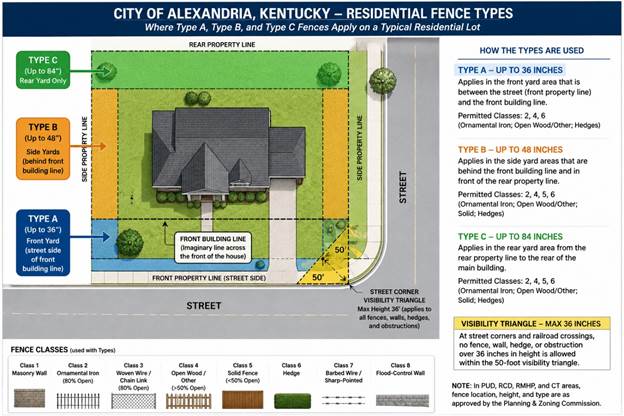
Local fence rules are primarily found in the Alexandria Zoning Ordinance, Article 8, Fences, Walls and Obstructions to View Regulations, and in Appendix D, Residential Fence Requirements. The city uses two related labels: a fence class describes the material or openness of the fence, while Type A, Type B, and Type C describe the residential height category that applies to a fence segment.
For ordinary residential fence review, Type A is the low/front-visible category and is limited to 36 inches; Type B is the intermediate category and is limited to 48 inches; and Type C is the taller rear or deeper-side screening category and is limited to 84 inches. The permitted fence materials for each type are written out below so the page can be used without interpreting the Appendix D diagram.
This page focuses on typical single-family residential fencing. If the jurisdiction’s adopted materials do not state a specific limit or requirement, this page notes that the code does not specify one.
Compiled From Alexandria Code of Ordinances, Alexandria Zoning Ordinance, Appendix D Residential Fence Requirements, Campbell County & Municipal Planning & Zoning Commission building and zoning permit materials, Kentucky Division of Water stream and floodplain permit materials, and City of Alexandria Subdivision Regulations as of June 2026.
GOVERNANCE
The City of Alexandria regulates residential fences through its zoning ordinance. The controlling fence provisions are Article 8, Fences, Walls and Obstructions to View Regulations, and Appendix D, Residential Fence Requirements.
The city’s adopted code identifies Campbell County Planning & Zoning Commission as the city’s Zoning Administrator and Building Inspector. Current permit materials are issued through the Campbell County & Municipal Planning & Zoning Commission.
Alexandria’s fence-class system is as follows:
• Class 1 – Masonry Walls: Masonry walls.
• Class 2 – Ornamental Iron: Ornamental iron fences that are 80% open.
• Class 3 – Woven Wire / Chain Link: Woven wire fences that are 80% open, including chain-link fences.
• Class 4 – Open Wood or Other Materials: Wood or other materials that are more than 50% open.
• Class 5 – Solid Fence: Solid wood or other materials that are less than 50% open.
• Class 6 – Hedges: Hedge fences.
• Class 7 – Barbed Wire or Sharp-Pointed Fence: Barbed wire or sharp-pointed fences.
• Class 8 – Flood-Control Wall: Earthen or concrete walls intended to contain or redirect flooding waters.
For ordinary residential uses in residential zones, Alexandria does not allow every fence class in every residential type. Type A allows only Class 2, Class 4, and Class 6. Type B and Type C allow Class 2, Class 4, Class 5, and Class 6.
PERMIT AND APPROVAL REQUIREMENTS
• Fence Permit / Zoning Permit: Campbell County & Municipal Planning & Zoning Commission permit materials list fences as requiring zoning review. The fee schedule identifies a Fence Permit for all zones with a permit fee.
• Building Permit Relationship: The local permit chart lists ordinary fences under the zoning column, not as a separate ordinary building-permit item. A fence project may involve building review only when another regulated component is included, such as an engineered retaining wall, pool barrier, grading work, floodplain construction, stream work, or other separately regulated improvement.
• Residential Fence Type Review: Fence review depends on the fence segment’s residential type and class. A standard solid privacy fence is Class 5, which is available only where Type B or Type C applies. A Class 5 solid fence is not listed as an allowed Type A residential fence.
• Special Districts and Planned Areas: In PUD, RCD, RMHP, and CT areas, the location, height, and type of fences and walls are controlled by approval of the Planning and Zoning Commission.
• Retaining Walls: A landscaping wall less than 4 feet in height requires no permit under the permit chart. An engineered wall less than 4 feet in height requires zoning review. An engineered wall 4 feet or more in grade requires building and zoning review. A fence placed with a retaining wall must also comply with the applicable fence class and height rules.
• Pools: Pool permits are separate from ordinary yard-fence permits. Above-ground pools are listed for zoning review, and in-ground pools are listed for building and zoning review, with electrical review required if electrical features are included. A fence used as part of a pool barrier is reviewed in the pool context rather than only as an ordinary yard fence.
• Road and Driveway Encroachments: A new curb cut requires an encroachment permit. If access is from a state road, permit materials direct applicants to obtain an encroachment permit from the Kentucky Department of Transportation District 6 and attach that permit to the local application.
• Floodplain or Stream Work: Fence-related work that includes construction in a floodplain, construction across or along a stream, fill, grading, bank work, or another activity that could obstruct flood flows or affect water quality may require review through the Kentucky Division of Water and the local floodplain coordinator before work begins.
FENCE PLACEMENT RULES
• Residential Type A: Type A is Alexandria’s low residential fence category. It applies to fence segments assigned to the Type A category under the residential fence requirements. Type A fences are limited to 36 inches and may use only Class 2 ornamental iron, Class 4 open wood or other open materials, or Class 6 hedges.
• Residential Type B: Type B is Alexandria’s intermediate residential fence category. It applies to fence segments assigned to the Type B category under the residential fence requirements. Type B fences are limited to 48 inches and may use Class 2 ornamental iron, Class 4 open wood or other open materials, Class 5 solid wood or other solid materials, or Class 6 hedges.
• Residential Type C: Type C is Alexandria’s taller residential screening category. It applies to fence segments assigned to the Type C category under the residential fence requirements. Type C fences are limited to 84 inches and may use Class 2 ornamental iron, Class 4 open wood or other open materials, Class 5 solid wood or other solid materials, or Class 6 hedges.
• Property Lines and Lot Lines: Article 8 measures fence and wall locations from lot lines. The ordinance does not state a setback requirement for standard residential fences from property lines; however, fences must be located entirely on the owner’s property and must not encroach into rights-of-way or easements.
• Cross Fences: Appendix D identifies cross-fence treatment separately from perimeter fence segments. Cross fences must provide access on one side, with a minimum gate width of 42 inches.
• Corner Lots and Railroad Crossings: No fence, wall, hedge, structure, or other obstruction over 36 inches may be placed, maintained, or continued within the triangular visibility area at a street corner or a street-railroad crossing. That triangle is formed by measuring 50 feet from the intersection of the applicable right-of-way lines and connecting those points with a straight line.
• Conservation Zone: In the Conservation Zone, Article 8 publishes separate fence rules. In front yards, Class 2 ornamental iron or Class 3 woven wire / chain link fences may be erected up to 96 inches. In side and rear yards, Classes 1, 2, 3, 4, 5, 6, or 7 fences and walls may be erected up to 96 inches. Class 8 flood-control walls are permitted only when they conform to applicable Corps of Engineers or City Engineer requirements.
• Drainage, Grading, and Surface Water: Where a fence project includes grading, fill, excavation, drainage changes, or erosion-control work, Campbell County & Municipal Planning & Zoning Commission materials may require grading, erosion-control, stormwater, or site-plan review.
• Utility Safety: Kentucky law requires notice through Kentucky 811 before excavation where Kentucky’s underground utility damage-prevention law applies. For fence projects that involve digging, including fence post holes, notice must be given not less than two full working days and not more than 10 full working days before excavation begins, unless a different future start date is allowed by law. Kentucky locate requests are valid for 21 calendar days from the initial request. Kentucky law also includes exemptions, including certain agricultural tilling and certain nonmechanized excavation on private property where no operator right-of-way or easement is encroached.
FENCE HEIGHT AND VISIBILITY RULES
• Type A Height: Type A residential fence segments are limited to 36 inches. Type A allows only Class 2 ornamental iron, Class 4 open wood or other materials, and Class 6 hedges.
• Type B Height: Type B residential fence segments are limited to 48 inches. Type B allows Class 2 ornamental iron, Class 4 open wood or other materials, Class 5 solid wood or other solid materials, and Class 6 hedges.
• Type C Height: Type C residential fence segments are limited to 84 inches. Type C allows Class 2 ornamental iron, Class 4 open wood or other materials, Class 5 solid wood or other solid materials, and Class 6 hedges.
• Solid Privacy Fence Height: A solid wood or other solid privacy fence is Class 5. For ordinary residential uses, Class 5 is available only in Type B and Type C locations. That means a solid residential privacy fence is limited to 48 inches where Type B applies and 84 inches where Type C applies.
• Open Fence Height: Ornamental iron fences that are 80% open are Class 2 and may be used in Type A, Type B, or Type C, subject to the applicable 36-inch, 48-inch, or 84-inch type height limit.
• Open Wood or Similar Fence Height: Wood or other materials that are more than 50% open are Class 4 and may be used in Type A, Type B, or Type C, subject to the applicable 36-inch, 48-inch, or 84-inch type height limit.
• Hedge Height: Hedges are Class 6 and may be used in Type A, Type B, or Type C, subject to the applicable 36-inch, 48-inch, or 84-inch type height limit.
• Visibility Triangle: Within the required corner or railroad-crossing visibility triangle, the maximum height is 36 inches for fences, walls, hedges, structures, plantings, and other obstructions.
• PUD, RCD, RMHP, and CT Areas: In PUD, RCD, RMHP, and CT areas, the location, height, and type of fences and walls are as approved by the Planning and Zoning Commission rather than only the Type A / B / C schedule.
• Conservation Zone Height: In the Conservation Zone, Article 8 allows front-yard Class 2 and Class 3 fences up to 96 inches, and side- or rear-yard Classes 1 through 7 fences and walls up to 96 inches, subject to the separate conservation-zone rule.
MATERIAL AND CONSTRUCTION LIMITS
For ordinary residential uses in residential zones, Alexandria’s code does not treat every fence material as available in every location. The residential Type A / B / C rules allow only the following materials:
• Type A Materials: Type A allows Class 2 ornamental iron that is 80% open, Class 4 wood or other materials that are more than 50% open, and Class 6 hedges. Type A does not list solid privacy fencing, masonry walls, chain link, barbed wire, or flood-control walls as permitted standard residential Type A fence classes.
• Type B Materials: Type B allows Class 2 ornamental iron that is 80% open, Class 4 wood or other materials that are more than 50% open, Class 5 solid wood or other materials that are less than 50% open, and Class 6 hedges.
• Type C Materials: Type C allows Class 2 ornamental iron that is 80% open, Class 4 wood or other materials that are more than 50% open, Class 5 solid wood or other materials that are less than 50% open, and Class 6 hedges.
• Chain Link: Chain link is included in Class 3. Ordinary residential Type A, Type B, and Type C rules do not list Class 3 as an allowed standard residential fence class. Chain link may appear only where another applicable Article 8 rule allows Class 3, such as the Conservation Zone rule.
• Masonry Walls: Masonry walls are Class 1. Ordinary residential Type A, Type B, and Type C rules do not list Class 1 as an allowed standard residential fence class. Masonry walls may appear only where another applicable Article 8 rule allows Class 1, such as the Conservation Zone side- and rear-yard rule.
• Barbed Wire or Sharp-Pointed Fences: Barbed wire or sharp-pointed fences are Class 7. Ordinary residential Type A, Type B, and Type C rules do not list Class 7 as an allowed standard residential fence class. Where barbed wire or sharp-pointed fencing is otherwise permitted in a zone other than R-RE, it must be at least 60 inches above ground level.
• Flood-Control Walls: Earthen or concrete walls intended to contain or redirect floodwaters are Class 8. They are not part of the ordinary residential Type A / B / C fence schedule. In the Conservation Zone, Class 8 walls are permitted only when they conform to applicable Corps of Engineers or City Engineer requirements.
• Fence on Retaining Wall: A combination fence and retaining wall may be used. The retaining-wall portion may extend to the level of the higher finished grade, but the fence portion must comply with the class and height permitted for the applicable zone and fence type.
• Finished Side: The code does not specify a finished-side orientation requirement for standard residential fences.
PRIVATE RESTRICTIONS
Private restrictions operate independently from City of Alexandria zoning and Campbell County & Municipal Planning & Zoning Commission permit review. These may include HOA covenants, subdivision restrictions, deed restrictions, private easements, access easements, drainage easements, utility easements, architectural-review covenants, recorded plat notes, private agreements, and other property-specific limitations.
A fence that satisfies public zoning and permit requirements may still be limited by private restrictions. The City of Alexandria does not publish a rule stating that private covenants are enforced as city fence regulations.
REVIEW AND ENFORCEMENT CONTEXT
Fence issues are typically reviewed during permit or approval review when required, and through complaint-based code enforcement. Examples include:
• A fence installed without the required zoning fence permit.
• A Type A fence over 36 inches, or a Type A fence using a class other than Class 2, Class 4, or Class 6.
• A Type B fence over 48 inches, or a Type B fence using a class other than Class 2, Class 4, Class 5, or Class 6.
• A Type C fence over 84 inches, or a Type C fence using a class other than Class 2, Class 4, Class 5, or Class 6.
• A solid privacy fence placed in a Type A residential fence segment.
• A chain-link fence treated as a standard residential Type A, Type B, or Type C fence, because chain link is Class 3 and is not listed in the ordinary residential Type A / B / C class schedule.
• A fence, wall, hedge, planting, structure, or other obstruction over 36 inches in the required 50-foot corner or railroad-crossing visibility triangle.
• A fence in a PUD, RCD, RMHP, or CT area where the location, height, or type requires Planning and Zoning Commission approval.
• A combination fence and retaining wall where the retaining-wall component or fence component does not match the applicable height, permit, or wall-review rule.
• A pool-barrier fence reviewed as part of a swimming-pool permit.
• A fence project involving grading, drainage, erosion control, stormwater, floodplain construction, stream work, or a road or driveway encroachment.
• A fence that conflicts with a right-of-way, access easement, drainage easement, utility easement, recorded plat, or other site limitation.
USING THIS INFORMATION
This page provides general orientation on how residential fence rules are structured and applied within City of Alexandria, based on publicly available source materials reviewed as of June 2026.
In addition to local fence rules, certain Kentucky laws apply statewide. See Statewide Fence Laws in Kentucky.
It is not legal advice and does not replace official ordinances, permits, surveys, or professional guidance. Rules and interpretations may change, and application may vary based on zoning district, site conditions, easements, rights-of-way, floodplain status, stormwater or drainage requirements, road or highway encroachment, historic district status, rural or agricultural context, livestock or farm-boundary context, pool-barrier use, and private restrictions such as HOA covenants, deed restrictions, private agreements, or agricultural conservation easements. Before purchasing materials or beginning construction, confirm current requirements and any site-specific limitations with Campbell County & Municipal Planning & Zoning Commission and any applicable private agreements. If this page conflicts with official ordinances, published guidance, or direction from City of Alexandria staff, the official sources control. For legal advice or legal interpretation, consult a licensed attorney.